
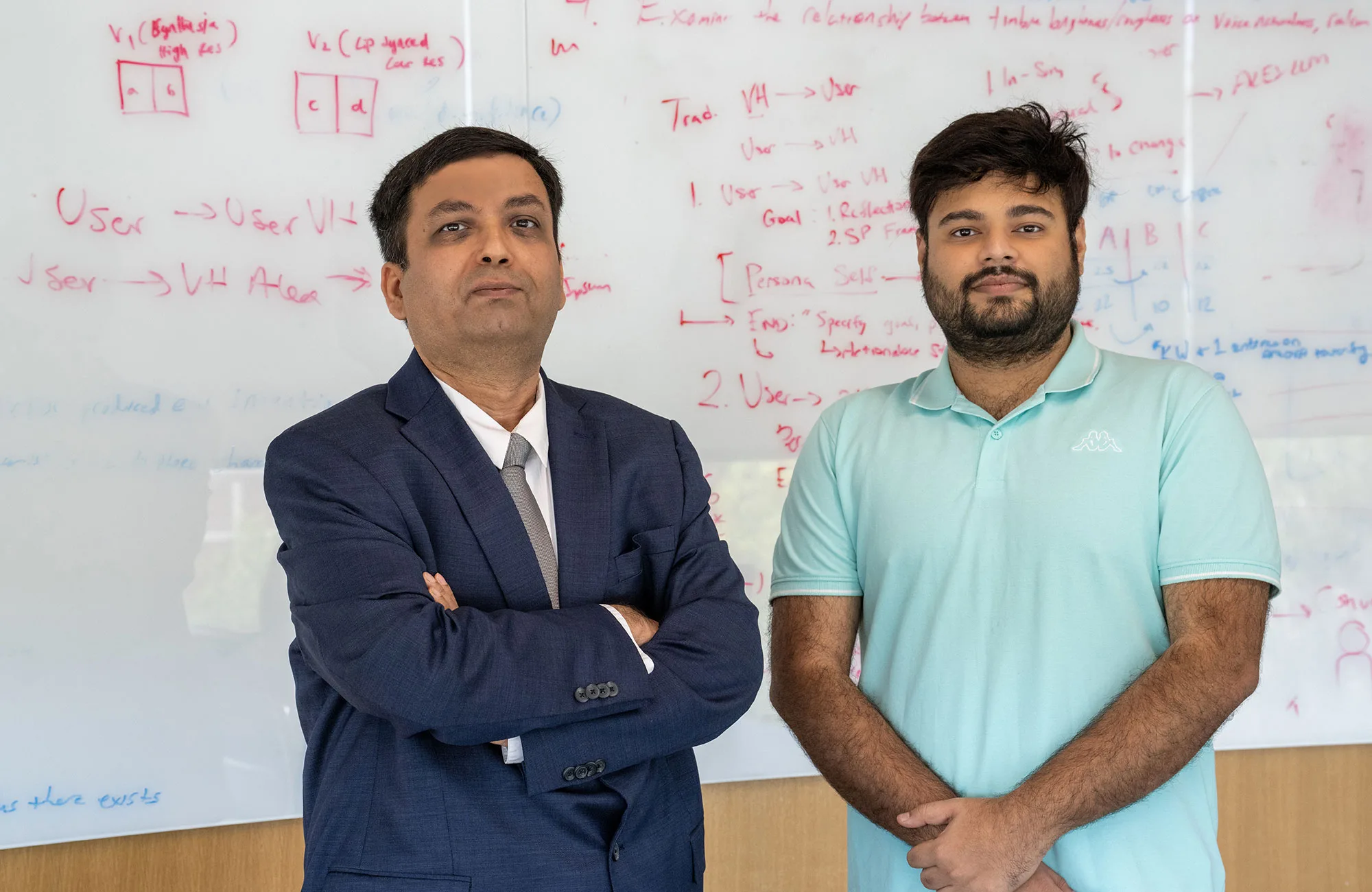
- Sumit Jha, Ph.D., has developed a system designed to prevent AI agents from going rogue.
- His ATLAS system scans an LLM and senses when the model begins to drift from the task and redirects.
- The system works inside AI models and does not impact speed or performance.
As artificial intelligence systems become increasingly capable of working on their own, keeping them focused on their designated tasks is a growing challenge.
University of Florida computer science professor Sumit Jha, Ph.D., is working to keep agents from “going rogue.” Jha and his team have developed a system that can detect when an AI model begins to drift from its assigned task and steer it back without retraining the model or adding significant computing demands.
The research comes as news reports have chronicled AI agents gaining more autonomy and occasionally behaving in ways their developers did not intend. Recent incidents have included AI agents accessing government websites and an Anthropic model submitting an anonymous tip to a police department in July, claiming to have information about an unsolved murder.
Jha, a professor in UF’s Department of Computer & Information Science & Engineering, or CISE, studies how to make AI systems more controllable and understandable. He is working to engineer simple, non-invasive tweaks to keep systems on task.
Jha and his collaborators have authored a paper entitled “Drift No More: Spectral Locking for Long-Horizon Open-Weight Multi-agent AI,” detailing a system, dubbed ATLAS, which stands for Algebraic Task–role Locking with Adaptive Spectral Memory.