
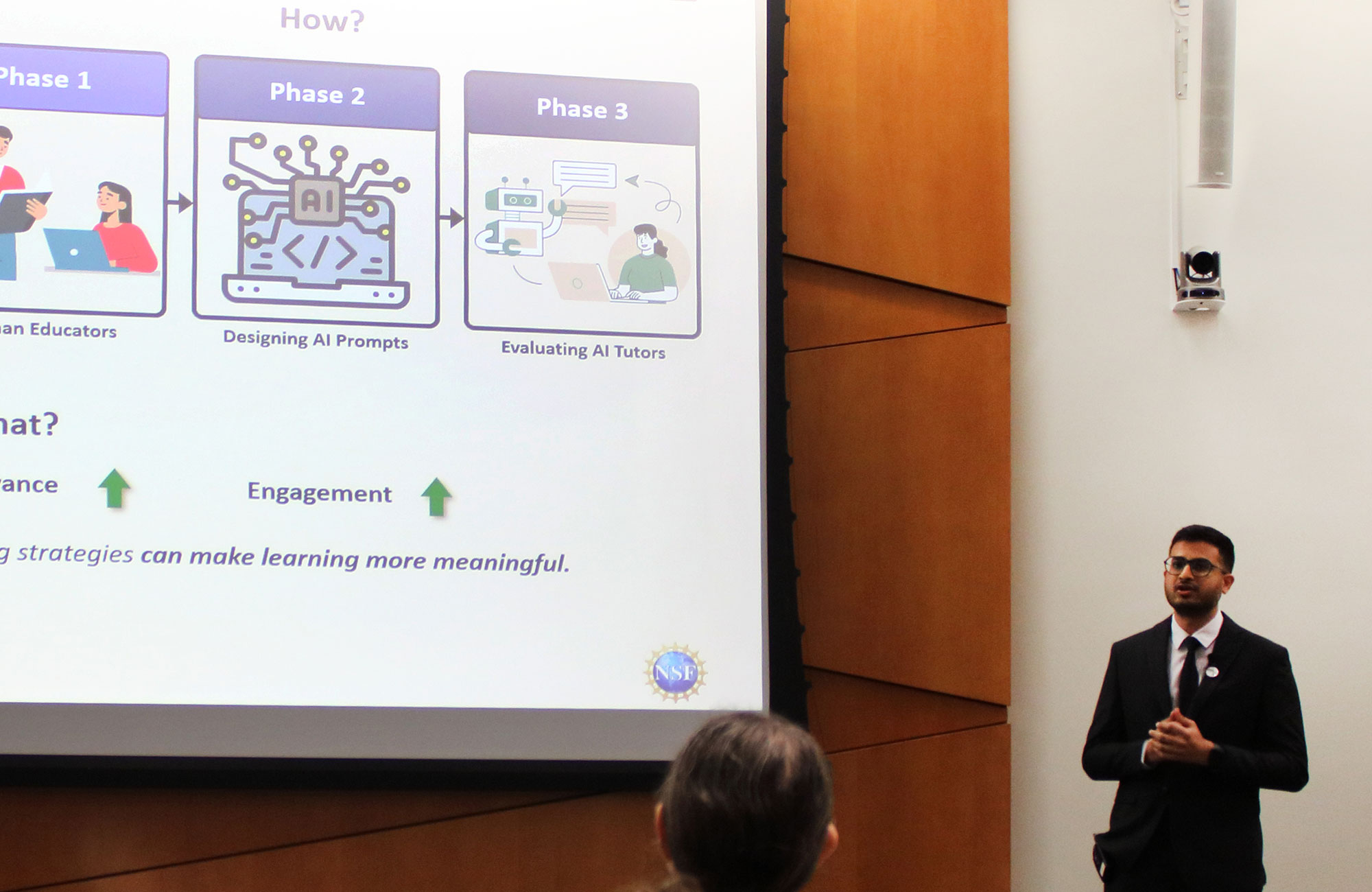
Doctoral student Abhishek Kulkarni earned third place in the University of Florida’s 2025 Three Minute Thesis competition, becoming the only finalist and winner representing the Herbert Wertheim College of Engineering.
Kulkarni is a Ph.D. candidate in human-centered computing whose research focuses on personalizing education through artificial intelligence. He is part of UF’s Department of Computer & Information Science & Engineering, known as CISE.
Developed by the University of Queensland, the 3MT competition challenges graduate students to present their thesis and its significance in just three minutes. The annual UF event draws students from across campus and helps strengthen their communication and storytelling skills for general audiences. This year, 45 students competed in the preliminary round, with 10 advancing to the finals for a second round of judging.
Kulkarni’s presentation, “From Human Educators to AI Tutors: Designing Interest-Based Learning at Scale,” distilled his work on AI-driven tutoring systems designed to make learning more meaningful for students. His research centers on interest-based learning, which uses students’ personal passions, such as sports, music or cooking, to explain academic content in ways that feel relevant and engaging.
A student struggling to understand probability, for example, might find abstract numbers confusing. But if the student is a soccer fan, an AI tutor could teach the same concepts using game statistics from their favorite team. The result, Kulkarni contends, are students who are more engaged and better able to grasp the material because it connects to something they care about.
Kulkarni’s inspiration for this work is rooted in his own experiences growing up and studying in India, where he completed his education through his bachelor’s degree. In the learning environments he knew, academic success was often measured by exam performance, leaving little room for personalization or connecting lessons to students’ interests.
“I grew up in a culture where education was everything, but a lot of learning still felt disconnected from my life,” Kulkarni said. “Those experiences are a big part of why I care so much about interest-based learning, and why I hope AI tools can support teachers by offering more personalized explanations.”
Condensing years of research into a three-minute talk proved to be a rewarding challenge.
“The most challenging part was letting go of so many details I cared about and choosing just one clear, simple story that the audience could connect with,” said Kulkarni.
Watching the other finalists strengthened his appreciation for effective storytelling and the importance of a strong core message. Kulkarni hopes his work will help students feel more connected to what they’re learning and support educators in making classroom experiences more relevant and impactful.