
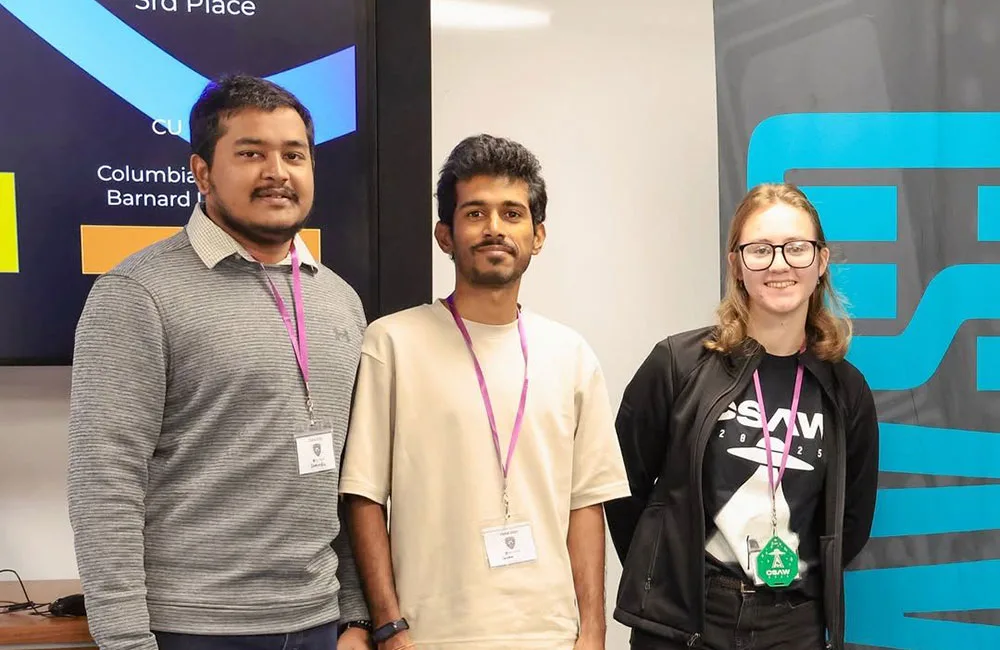
A team of University of Florida computer engineering graduate students recently placed second among U.S. universities in the CSAW Embedded Security Challenge, one of the world’s leading cybersecurity competitions hosted by New York University.
Competing under the name Gator Bytes, team members Sahan Sanjaya, Dakshina Tharindu and Dumindu Bandara impressed judges with their innovative use of artificial intelligence to detect hardware vulnerabilities and extract sensitive data from electronic systems. The team is from UF’s Trustworthy and Intelligent Systems Lab, known as TISL.
This year’s CSAW security challenge featured three divisions: United States, Europe and India. UF was one of 10 universities to qualify as finalists in North America, joining programs such as Georgia Tech, Purdue and Columbia. The University of Illinois Urbana – Champaign took first place.
The competition, part of the NYU Center for Cybersecurity Awareness week, brings students together from across the globe to solve real-world security problems. For Gator Bytes, earning second place in the U.S. division was both a technical achievement and a valuable learning experience.
“This recognition improves their confidence that they are truly cybersecurity experts and can compete with the best in the world,” said the team’s adviser, Prabhat Mishra, Ph.D., professor in UF’s Department of Computer & Information Science and Engineering (CISE). “Most importantly, it motivates them to solve complex security challenges.”
The embedded security challenge consisted of two phases. In the qualifying round, teams were required to design a side-channel attack and propose mitigation strategies. After advancing to the finals, the team solved eight advanced challenges involving both side-channel and fault-injection attacks.
To stand out, Gator Bytes utilized deep learning and large language models to automate hardware attacks and develop intelligent defenses in a new era of silicon warfare.
“During our preliminary evaluation, we found subtle variations in power measurements due to vulnerable code segments,” Bandara explained. “In particular, we tried to reduce manual signal annotations and labelling as much as possible by utilizing end-to-end deep learning and machine learning models.”
Managing eight advanced tasks under time constraints while balancing academic and research responsibilities proved challenging. Gator Bytes divided the workload according to each team member’s strength.
“We already had the necessary background and foundation to approach the challenges,” said Sanjaya. “By assigning different attack strategies according to our expertise, we were able to investigate them in parallel and ultimately arrive at the best-performing solution.”
The team credits its success to the guidance of Professor Mishra and their research experience in the TISL lab, which provided the foundation for their work.
“This competition gave us valuable hands-on experience with side-channel attack techniques not typically covered in traditional coursework,” shared Tharindu. “It exposed us to novel methods of exploiting hardware vulnerabilities from power analysis and solidified our interest in hardware security research.”
Competing at NYU against elite global teams, team members gained a deeper appreciation for the global cybersecurity landscape and strengthened their outlook for working in a cybersecurity role.
“Presenting our work in New York and competing against top teams from around the world was an incredible experience,” Tharindu said. “Winning second place showed us how valuable teamwork, persistence, and creative problem-solving are in real technical environments.”