
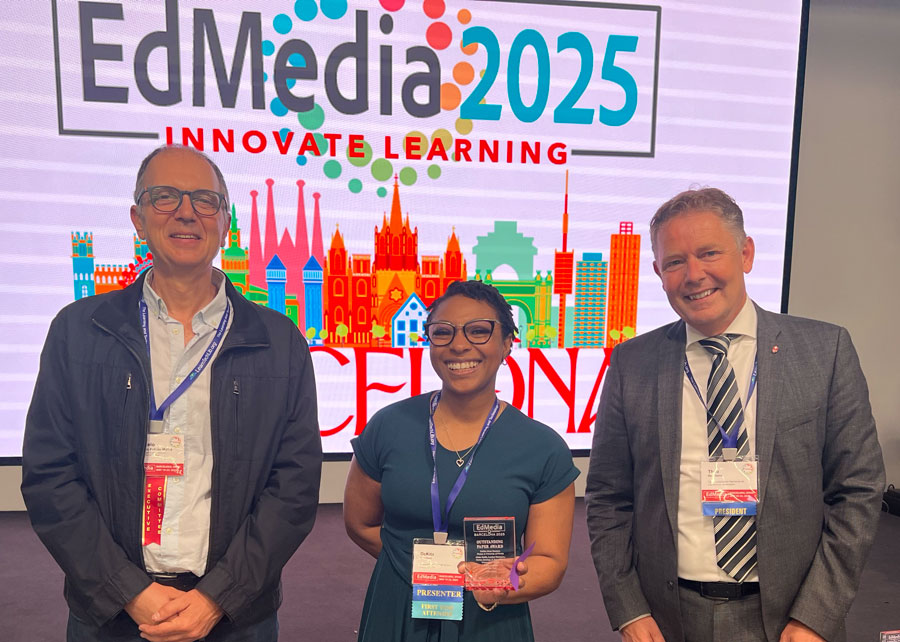
A team from the Department of Computer & Information Science & Engineering (CISE) recently received an outstanding paper award at the EdMedia conference for research that personalizes math word problems to bridge cultural gaps in education.
Called “InterestMe Math: A Math Word Problem Rewrite System Integrating Career Interests to Enhance Learning Outcomes,” the University of Florida engineering research project is about incorporating students’ personal career aspirations to help navigate math word problems and enhance classroom engagement.
Co-authored by a CISE team that includes department chair and distinguished professor Juan E. Gilbert, Ph.D., the paper is the foundation for DeKita Rembert’s doctoral dissertation and reflects a deep commitment to helping students feel connected.
“By transforming learning models to integrate students’ interests, identities and goals, I hope to combat disconnection and help more students stay engaged, feel seen and ultimately thrive academically and professionally,” said Rembert, a former student of Gilbert’s who now holds her Ph.D.
Grounded in the expectancy-value theory framework, the research aims to enhance math comprehension and learning outcomes. Researchers conducted a study with 29 fifth- and sixth-grade students, comparing traditional math problems to rewritten ones integrating themes based on student career aspirations. The model was designed with input from students and teachers using culturally relevant content and drawing on more than 600 career paths.
In the study’s qualitative feedback, students expressed higher perceived comprehension when working with InterestMe math and described math problems as “fun” or “cool.” The responses support continued exploration of contextualized, interest-based learning.
Based on the quantitative results, students from higher-equity schools scored significantly better than students from lower-equity schools on standard, non-personalized math word problems. However, when the problems were personalized and tailored to students’ career interests, there was no significant difference in performance between the two groups. These findings may suggest that personalized problems might help level the playing field, especially for students who stand to benefit from them the most.
“I’m especially grateful to my co-authors, Alaina Smith, London Thompson, Darian Jennings and Dr. Juan Gilbert from the University of Florida, and to Dr. Amber Solomon, for their invaluable collaboration on this paper,” said Rembert. “Their support helped extend its visibility and impact.”
The study represents a pioneering effort to integrate interest-based learning to make math more engaging and accessible, particularly for students from underrepresented backgrounds whose identities are often not reflected in traditional curriculum.