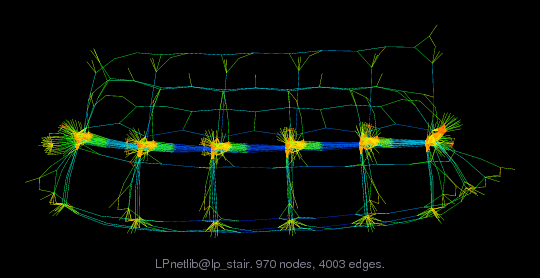
Matrix: LPnetlib/lp_stair
Description: Netlib LP problem stair: minimize c'*x, where Ax=b, lo<=x<=hi
|
| (bipartite graph drawing) |
 |
| Matrix properties | |
| number of rows | 356 |
| number of columns | 614 |
| nonzeros | 4,003 |
| structural full rank? | yes |
| structural rank | 356 |
| # of blocks from dmperm | 1 |
| # strongly connected comp. | 1 |
| explicit zero entries | 0 |
| nonzero pattern symmetry | 0% |
| numeric value symmetry | 0% |
| type | real |
| structure | rectangular |
| Cholesky candidate? | no |
| positive definite? | no |
| author | M. Saunders |
| editor | D. Gay |
| date | |
| kind | linear programming problem |
| 2D/3D problem? | no |
| Additional fields | size and type |
| b | full 356-by-1 |
| c | full 614-by-1 |
| lo | full 614-by-1 |
| hi | full 614-by-1 |
| z0 | full 1-by-1 |
Notes:
A Netlib LP problem, in lp/data.  For more information
send email to netlib@ornl.gov with the message:

	 send index from lp
	 send readme from lp/data
	 send minos from lp/data

------------------------------------------------------------------------------
This LP problem is the source of four sparse matrices in the Harwell/Boeing
sparse matrix collection: STR_0, STR_200, STR_400, and STR_600.  Those four
matrices are square, nonsingular basis matrices that occured during the
solution of STAIR.
------------------------------------------------------------------------------

The following are relevant excerpts from lp/data/readme (by David M. Gay):

The column and nonzero counts in the PROBLEM SUMMARY TABLE below exclude
slack and surplus columns and the right-hand side vector, but include
the cost row.  We have omitted other free rows and all but the first
right-hand side vector, as noted below.  The byte count is for the
MPS compressed file; it includes a newline character at the end of each
line.  These files start with a blank initial line intended to prevent
mail programs from discarding any of the data.  The BR column indicates
whether a problem has bounds or ranges:  B stands for "has bounds", R
for "has ranges".  The BOUND-TYPE TABLE below shows the bound types
present in those problems that have bounds.

The optimal value is from MINOS version 5.3 (of Sept. 1988)
running on a VAX with default options.

                       PROBLEM SUMMARY TABLE

Name       Rows   Cols   Nonzeros    Bytes  BR      Optimal Value
STAIR       357    467     3857      27405  B    -2.5126695119E+02

        BOUND-TYPE TABLE
STAIR      UP    FX FR

From Michael Saunders, Systems Optimization Laboratory at Stanford University.
When included in Netlib: Explicit zeros omitted;
cost coefficients negated.

The following are relevant excerts from lp/data/minos (by Michael Saunders),
regarding experience with MINOS 5.0 on the problems he provided:

                                                     (unscaled)   (scaled)
File   Name    Rows  Cols  Elems  Optimal Objective  Itns  Time  Itns  Time
---- --------  ----  ----  -----  -----------------  ----  ----  ----  ----
 11. STAIR      357   467   3867  2.5126695E+02 MAX   519  15.7   389  13.1

* Objective  is the first row of type N.  It is minimized except as shown.

* Itns       is the number of iterations required to solve the problem
             by the primal simplex method, as implemented in the Fortran
             code MINOS 5.0 (May 1985), using default values for all
             parameters.  (The initial basis is triangular.)

* Time       is the processor time required on an IBM 3081K.  The MINOS
             source code was compiled with the IBM Fortran 77 compiler
             VS FORTRAN, using the options NOSDUMP, NOSYM and OPT(3).
| Ordering statistics: | result |
| nnz(V) for QR, upper bound nnz(L) for LU, with COLAMD | 40,071 |
| nnz(R) for QR, upper bound nnz(U) for LU, with COLAMD | 15,465 |
| SVD-based statistics: | |
| norm(A) | 14.6486 |
| min(svd(A)) | 0.256499 |
| cond(A) | 57.1098 |
| rank(A) | 356 |
| sprank(A)-rank(A) | 0 |
| null space dimension | 0 |
| full numerical rank? | yes |
| singular values (MAT file): | click here |
| SVD method used: | s = svd (full (A)) ; |
| status: | ok |

For a description of the statistics displayed above, click here.
Maintained by Tim Davis, last updated 12-Mar-2014.
Matrix pictures by cspy, a MATLAB function in the CSparse package.
Matrix graphs by Yifan Hu, AT&T Labs Visualization Group.