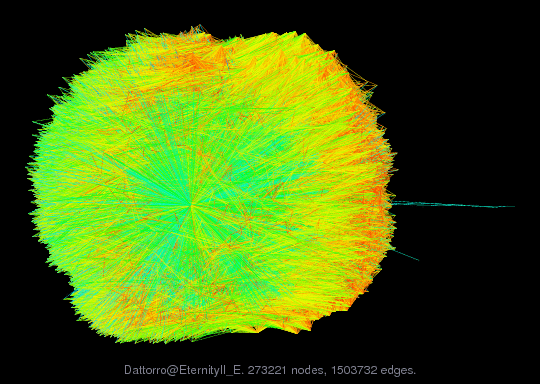
Matrix: Dattorro/EternityII_E
Description: Dattorro Convex Optimization of Eternity II (first reduction)
|
| (bipartite graph drawing) |
 |
 |
| Matrix properties | |
| number of rows | 11,077 |
| number of columns | 262,144 |
| nonzeros | 1,503,732 |
| structural full rank? | yes |
| structural rank | 11,077 |
| # of blocks from dmperm | 5 |
| # strongly connected comp. | 1 |
| explicit zero entries | 0 |
| nonzero pattern symmetry | 0% |
| numeric value symmetry | 0% |
| type | integer |
| structure | rectangular |
| Cholesky candidate? | no |
| positive definite? | no |
| author | J. Dattorro |
| editor | T. Davis |
| date | 2011 |
| kind | optimization problem |
| 2D/3D problem? | no |
| Additional fields | size and type |
| b | sparse 11077-by-1 |
Notes:
Dattorro Convex Optimization of Eternity II, Jon Dattoro

An Eternity II puzzle (http://www.eternityii.com/) problem
formulation A*x=b is discussed thoroughly in section 4.6.0.0.15 of
the book Convex Optimization & Euclidean Distance Geometry which
is freely available. That A matrix is obtained by presolving a
sparse 864,593-by-1,048,576 system.  The 3 problems in this set
contains three successive reductions, each equivalent to that
larger system:

   * EternityII_E: a 11077-by-262144 system E*x=tau, where tau is
       11077-by-1.  This is the million column Eternity II matrix
       having redundant rows and columns removed analytically.
       In the UF Collection, E is the Problem.A matrix, and tau
       is Problem.b.  All entries in E are from the set {-1,0,1,2}.
       tau is binary and very sparse.

   * EternityII_Etilde: a 10054-by-204304 system Etilde*x=tautilde
       with tautilde of size 10054-by-1.  The system has columns
       removed corresponding to some known zero variables
       (removal produced dependent rows).  In the UF Collection,
       Etilde is the Problem.A matrix, and tautilde is Problem.b.
       All entries in Etilde are from the set {-1,0,1}.
       tautilde is binary and very sparse.

   * EternityII_A: a 7362-by-150638 system A*x=b, where b is
       7362-by-1.  This system has columns removed not in
       smallest face (containing tautilde) of polyhedral cone K =
       { Etilde*x | x >= 0 }.

The following linear program is a very difficult problem that
remains unsolved:

    maximize_x z'*x, subject to A*x=b and x >= 0

The matrix A in the EternityII_A problem is sparse, having only
782,087 nonzeros.  All entries of A are integers from the set
{-1,0,1}.  The vector b is binary, with only 358 nonzeros.

Direction vector z is determined by Convex Iteration:

    maximize_z z'*x^{star},
    subject to 0 <= z <= 1 and z'*1 = 256

(for a vector x, x >= 0 means all(x>-0) in MATLAB notation)

These two problems are iterated to find a minimal cardinality
solution x.  Constraint A*x=b bounds the variable from above by 1.
Any minimal cardinality solution is binary and solves the Eternity
II puzzle. The Eternity II puzzle is solved when
z^{star}'*x^{star} = 256.

Minimal cardinality of this Eternity II problem is equal to number
of puzzle pieces, 256.

Comment: The technique, convex iteration, requires no modification
(and works very well) when applied instead to mixed integer
programming (MIP, not discussed in book). There is no modification
to the linear program statement here except 256 variables,
corresponding to the largest entries of iterate x^{star}, are
declared binary.

For more details, see
http://www.convexoptimization.com/wikimization/index.php
/Dattorro_Convex_Optimization_of_Eternity_II (url is wrapped),
and https://ccrma.stanford.edu/~dattorro/ .
| Ordering statistics: | result |
| nnz(V) for QR, upper bound nnz(L) for LU, with COLAMD | 867,810,002 |
| nnz(R) for QR, upper bound nnz(U) for LU, with COLAMD | 11,712,296 |
| SVD-based statistics: | |
| norm(A) | 264.319 |
| min(svd(A)) | 7.18761e-14 |
| cond(A) | 3.67743e+15 |
| rank(A) | 11,076 |
| sprank(A)-rank(A) | 1 |
| null space dimension | 1 |
| full numerical rank? | no |
| singular value gap | 3.43781e+12 |
| singular values (MAT file): | click here |
| SVD method used: | s = svd (full (R)) ; where [~,R,E] = spqr (A') with droptol of zero |
| status: | ok |

For a description of the statistics displayed above, click here.
Maintained by Tim Davis, last updated 12-Mar-2014.
Matrix pictures by cspy, a MATLAB function in the CSparse package.
Matrix graphs by Yifan Hu, AT&T Labs Visualization Group.