Matrix: Boeing/nasa1824
Description: STRUCTURE FROM NASA LANGLEY, 1824 DEGREES OF FREEDOM
|
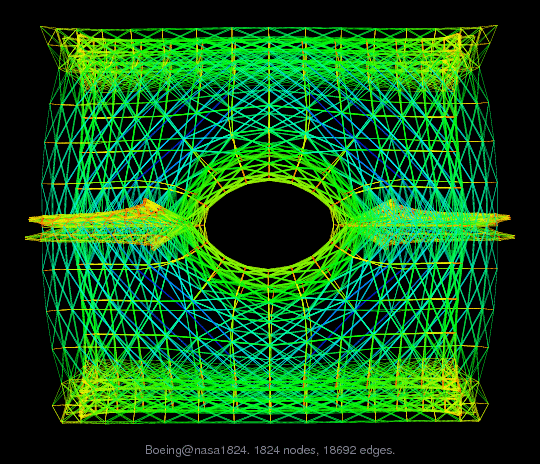
| (undirected graph drawing) |
 |
| Matrix properties | |
| number of rows | 1,824 |
| number of columns | 1,824 |
| nonzeros | 39,208 |
| structural full rank? | yes |
| structural rank | 1,824 |
| # of blocks from dmperm | 1 |
| # strongly connected comp. | 1 |
| explicit zero entries | 0 |
| nonzero pattern symmetry | symmetric |
| numeric value symmetry | symmetric |
| type | real |
| structure | symmetric |
| Cholesky candidate? | yes |
| positive definite? | no |
| author | R. Grimes |
| editor | T. Davis |
| date | 1995 |
| kind | duplicate structural problem |
| 2D/3D problem? | yes |
| Additional fields | size and type |
| b | full 1824-by-1 |
Notes:
Let A1=Nasa/nasa1824 and A2=Boeing/nasa1824.  A1 and A2 have the same
nonzero pattern.  A1 and A2 differ in value in only 386 entries out of
39208, and only in 21 columns of the lower triangular part;
tril(A(196:321,196:216)) and the same rows of the upper triangular
part.  The magnitudes of the entries in A2 in this region of the
matrix are all tiny, and have only 9 digits if printed in base-10
(unlike the other entries, which have full precision).  I suspect A2
(Boeing/nasa1824) is a corrupted version of A1 (Nasa/nasa1824).
| Ordering statistics: | result |
| nnz(chol(P*(A+A'+s*I)*P')) with AMD | 69,309 |
| Cholesky flop count | 4.6e+06 |
| nnz(L+U), no partial pivoting, with AMD | 136,794 |
| nnz(V) for QR, upper bound nnz(L) for LU, with COLAMD | 157,808 |
| nnz(R) for QR, upper bound nnz(U) for LU, with COLAMD | 289,058 |
| SVD-based statistics: | |
| norm(A) | 2.12172e+07 |
| min(svd(A)) | 3.60113 |
| cond(A) | 5.8918e+06 |
| rank(A) | 1,824 |
| sprank(A)-rank(A) | 0 |
| null space dimension | 0 |
| full numerical rank? | yes |
| singular values (MAT file): | click here |
| SVD method used: | s = svd (full (A)) ; |
| status: | ok |

For a description of the statistics displayed above, click here.
Maintained by Tim Davis, last updated 12-Mar-2014.
Matrix pictures by cspy, a MATLAB function in the CSparse package.
Matrix graphs by Yifan Hu, AT&T Labs Visualization Group.