public void nearest(int i, int d, int [] reach).
The invocation g.nearest(theI, theD, theReach)
labels all
vertices j such that the shortest path from
theI to j has at most
theD edges.
You may assume that, initially,
theReach[j] > theD for all vertices
j. When done,
theReach[j] equals the length of the shortest path
from theI for those vertices j
that have been labeled
by your code. For the remaining vertices, theReach[j]
is unchanged.
- (a)
-
[10]
Write Java code for the method
nearest. If you need to use a stack or a queue, use eitherArrayStack(the relevant methods areempty,push, andpop), orArrayQueue(the relevant methods areisEmpty,put, andremove). Use iterators to move around the graph. The statement
Iterator iw = iterator(w);
gets you an iterator for vertexwof the graph, and the statementu = ((EdgeNode) iw.next()).vertex;gets you a vertex that is adjacent to vertexw.
(Hint: one of the standard search methods may work.) - (b)
- [2] What is the complexity of your labeling method as a function of the number of vertices that are labeled and of their out-degrees? Provide this complexity under the assumption that adjacency lists are used. Explain your analysis (a few lines only).
- (a)
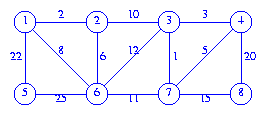
- [4] A minimum-cost spanning tree is to be constructed using Kruskal's method. Describe the working of Kruskal's method on this graph. Draw the spanning tree that is constructed and also give the steps (draw figures and state the dicision made at each step) used to arrive at this tree. What is the cost of the constructed tree?
- (b)
- [4] Do part (a) using Prim's method instead of Kruskal's method.
x[] is a sorted array iff
x[0] < x[1] < x[2] < ... < x[x.length - 1].
A sorted aray has an equilibrium point iff there
is an i, 0 <= i < x.length
for which x[i] = i.
- (a)
-
[10]
Write Java code for the method
public int equilibriumPoint(int [] x). You may assume thatxis a sorted array. If the sorted array has no equilibrium point, your method should return-1. If the sorted array has an equilibrium point, your method should return an integerisuch thatx[i] = i. Use divide and conquer. - (b)
- [2] What is the time complexity of your method? Explain how you arrived at this complexity.
- (a)
-
[4]
In the Bellman-Ford single-source all-destinations shortest-paths algorithm,
d(v,k)is the length of a shortest path from the source vertex to vertexv, under the constraint that the path has at mostkedges;p(v,k)is the vertex (if any) that comes just before vertexvon this constrained shortest path. Thepmatrix computed for a certain7vertex graph is given below.v ------> [1] [2] [3] [4] [5] [6] [7] [0] - - - - - - - [1] - 1 1 - - 1 1 k [2] - 1 6 2 6 1 6 | [3] - 1 6 2 3 1 4 | [4] - 1 6 5 3 1 5 V [5] - 4 6 5 3 1 5 [6] - 4 6 5 3 1 2The source vertex is vertex1. Determine the shortest path from the source to vertex7. Show how you obtained your answer. - (b)
-
[4]
Consider Floyd's all-pairs shortest-paths algorithm. This is based on the
dynamic-programming recurrence:
c(i,j,k) = min{c(i,j,k-1), c(i,k,k-1) + c(k,j,k-1}, k > 0
wherec(i,j,k)is the length of the shortest path fromitojthat goes through no vertex larger thank. Explain why the following pseudocode computesc(i,j) = c(i,j,n)when started withc(i,j) = c(i,j,0)(nis the number of vertices in the graph).for (int k = 1; k <= n; k++) for (int i = 1; i <= n; i++) for (int j = 1; j <= n; j++) c(i,j) = min{c(i,j), c(i,k) + c(k,j)} - (c)
-
[4]
nitems are to be packed into the fewest number of bins. The height of each bin ish, and the height of itemiish(i). Each bin must contain a consecutive set of items. For example, if items 2 and 5 are packed into the same bin, then items 3 and 4 must also be packed into this bin. The items in a bin are packed in ascending order of item index from bottom to top. For example, if items 2 through 5 are packed in a bin, then item 2 is at the bottom and item 5 at the top. Letp(i)be the height of padding needed at the bin bottom (or top) when itemiis the bottom (top) item of the bin. So, items 2 through 5 can be packed into the same bin iffh(2) + h(3) + h(4) + h(5) + p(2) + p(5) <= h. You may assume thath(i) + 2p(i) <= hfor alli. Letbins(j)be the minimum number of bins needed to pack itemsjthroughn. Sobins(n+1) = 0. Obtain a dynamic programming recurrence forbins(j),1 <= j <= n. - (d)
-
[8]
Students in an algorithms class obtained the following dynamic programming
recurrence for a certain problem.
q(i,j) = 0, i = n+1 or j = m+1

q(i,j) = 1 + q(i+1, j+1), if ai = bj

q(i,j) = max{q(i+1, j), q(i, j+1)}, otherwise
Write a nonrecursiveO(mn)time algorithm to computeq(i,j),1 <= i <= n+1, 1 <= j <= m+1. Pseudocode will suffice.a1...an, b1...bm, mandnare inputs to your algorithm. Show that the complexity of your algorithm isO(mn).